

Deep Thought 6: The Mind in the Machine
Throwback Thursday

This is the first of a trilogy of posts I wrote over a decade ago about technology and humanity. I’ll run the next two over the following weeks (unless something really exciting happens and I have an old post that sheds light on it.)
This first post looks at the economic effects of technology. The next one looks at broader social and political effects. The last post bends philosophical.
I’ll put footnotes on specific points where items I cited did not really hold up. At the end I’ll post a coda revisiting the main themes.
Finally, there is no Deep Thought 1-5. The origin of the title will be revealed at the conclusion of this series. Feel free to contact me if you think you know where it comes from. (Also, there are no vice presidents in this post, but tomorrow you’ll get your Veeply Roundup!)
Deep Thought 6: The Mind in the Machine
I recently read an article about the business philosopher Clayton Christensen.1 His core idea is about how well established businesses are overtaken by disruptive innovations at the bottom of their market. A classic example is the steel mills being overtaken by mini-mills. At first big steel was happy to cede the low end of the market to the new mini-mills. The low end of the market was rebar (reinforcing bars) that were buried inside concrete to add strength. It was the cheapest steel and had the lowest profit margins. The big steel companies were happy to cede this aspect of the business. But the mini-mills started getting better, moving up the ladder of sophisticated and profitable products until they were challenging big steel at the top of their game. Big steel had enormous physical plants and sunk costs and suddenly could not compete.
This has happened in industry after industry according to Christensen. When transistor radios first came out they were junk compared to the sophisticated vacuum tube radios, but they were cheap. Teenagers, who didn’t have any money, bought them. Over time the transistor radios improved and tube radios basically don’t exist
anymore.
This also occurs in military affairs. When the Bronze Age Greek civilizations were overrun by the iron using Dorians, it wasn’t that the Doric iron weapons were better. The bronze weapons of the sophisticated Greek civilization were quite advanced – but the iron weapons were much cheaper and easier to make.
Here is what struck me as I read about Christensen. Computers are getting better and better at what they do and automation is replacing a lot of jobs humans do – and not just in clerical tasks – but also potentially in some sophisticated ones.
Watson, the IBM computer that defeated several Jeopardy champions (and my old boss) equaled the human mind in a very specific area and occupies several rooms. But, soon enough Watson will be living in your phone (Siri is a very bad, but relatively cheap, fore-runner).2
Your Personal Robot DJ
The Muzak Corporation no longer develops the cheesey, bland sound-track known as elevator music. They generate sophisticated packages of music for different
environments, including custom-made selections that add an audio dimension to a
carefully tailored environment (retailers are the major customers.) In this New Yorker profile, one of the Muzak architects asks the author a series of questions about himself and creates a “personal audio imaging profile” and a six-song personalized
CD. The author is struck that while he hadn’t heard of any of the artists on the CD, he really liked it and even bought some CDs by the artists.
Could a computer do that?
Not yet, but consider the automatic iTunes recommendations based on past purchases (personally, I know very little about this). Right now they may be of limited utility to
serious music aficionados appear eons away from the sophisticated capacities of
the Muzak Corporation. But the algorithms of iTunes and other online music sellers will become continually more sophisticated. What happens to the company when an individual or business can subscribe to a highly personalized music selection service for a far lower price?
This example is at the high-end, but there are innumerable examples at the low-end as well. Automated cars are close to being a technological reality. How many people work as drivers around and what will they do when robot vehicles do all of the driving.3
One can imagine the Muzak architects finding new and interesting things to do. But what about the many, many people who drive for a living? Will they start writing screenplays or becoming research scientists?
This scenario will play out in industry after industry. The very best maps are still made by hand, but computer generated maps are cheaper and usually good enough.
This would sounds like the argument of the “buggy whip makers” who were put out of business with the coming of the automobile. But I don’t think so. Most inventions replaced human brawn – which isn’t what people are best at anyway (pound for pound most animals are far stronger.) People still had hands, minds, and mouths, which could (particularly in combination) perform functions that were not easily automated. But these new capabilities are edging into core human functions.
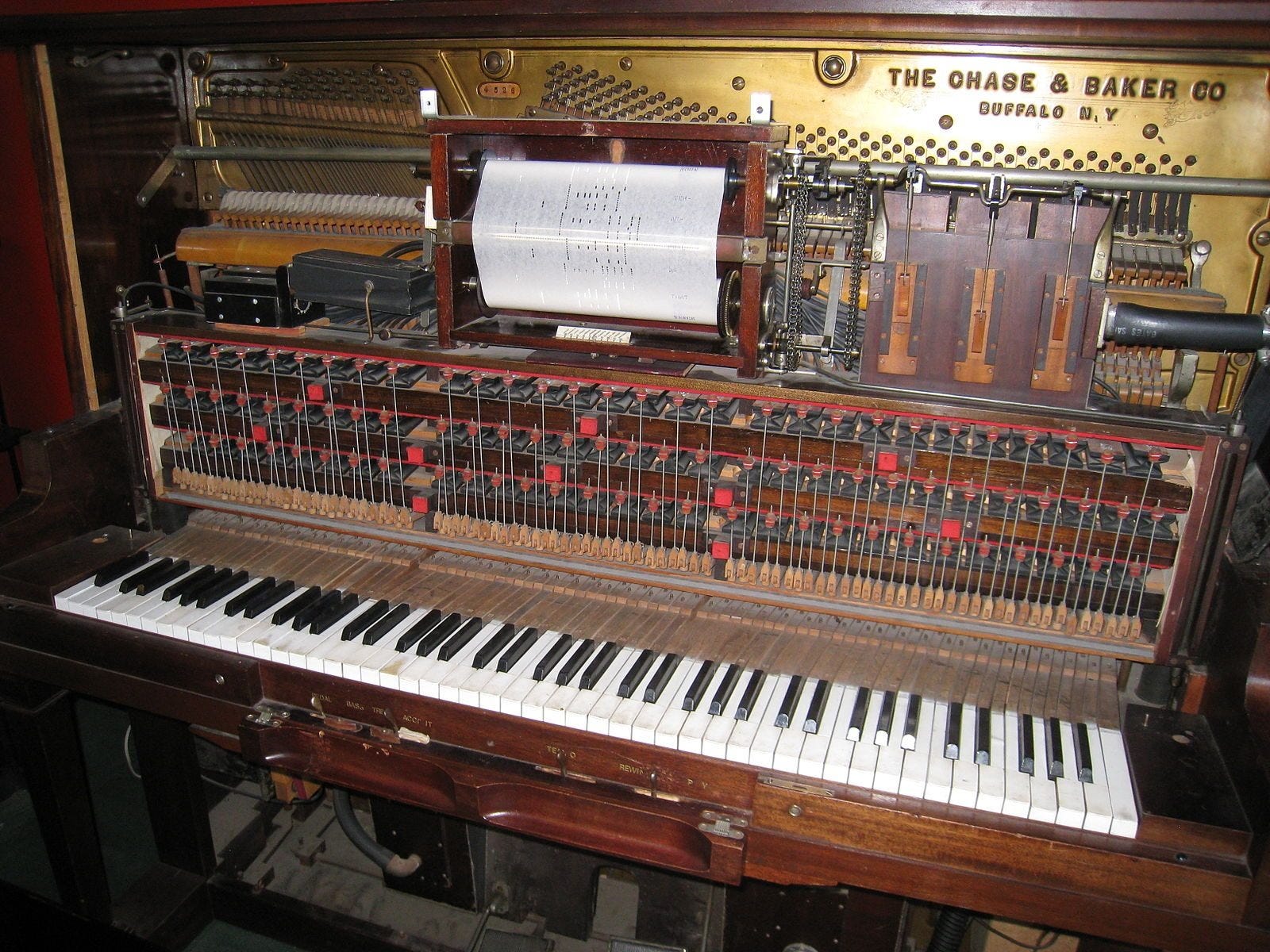
Are we sliding into the world of Kurt Vonnegut’s novel Player Piano in which machines do all the work and people are left with nothing to do?
Coda
A few days ago I posted on the various socials:
Hint: fall in love with HVAC. Then the computers need you, instead of the other way around.
This highlights perhaps the biggest thing I got wrong. Like most people thinking about technology eliminating jobs, I focused on blue-collar work. But it turns out that there are a lot of challenges to building robots that can function efficiently and consistently in environments that are not strictly controlled. (This is despite the cool videos—those are usually in carefully curated situations.)
In terms of manipulating items in the real world (say repairing infrastructure and machinery) people are just way better… at least for the foreseeable future. Many blue collar jobs, particularly the skilled trades, are safe. Even a lot of lower-skilled manufacturing is pretty hard to automate. These jobs aren’t immune from the effects of AI. Where robots can be used, they can re-shape the workplace in ways detrimental to people. This can be physical, such as the Amazon robots that move faster than the humans who pack and unpack the boxes (a complex physical task in which the robots struggle.) It can also be psychological. A workspace optimized for the robots may be less friendly to people, isolating workers and preventing them from interacting with one another and reducing physical contact. There are also areas, like mining, where robots replacing people will, on the whole, be an improvement.
For skilled work, blue-collar or white collar, the future is in human-machine teaming. AI tools (whether physical or virtual) can be huge boons to efficiency and effectiveness. AI has not replaced doctors, medicine is simply too complicated. One field of medicine, radiology, was believed to be particularly vulnerable to AI. It turns out that AI has been useful to radiologists, performing certain complex and tedious functions and providing alternate reads on scans. Doctors and nurses are beleaguered with paperwork, AI can be a huge assist relieving that tedious burden. For blue collar workers there may be suites of little robots that can explore infrastructure and help humans find problems.
I see three problems.
Lots of white collar workers do work that is in fact tedious paperwork stuff that can be replaced. In my own career I sometimes worked on such documents. Much of it would be required yadda-yadda, with occasional critical bits sprinkled in.
I haven’t touched on AI slop, but we’ve how AI can generate enormous amounts of material. Is that material any good? Is it misinformation/hallucinations? Is it making us all dumber and lazier? Do we even know it is doing this. I’ve thought a lot about this. Conservatives (in the great sense of the word) always worry about technology screwing up humanity. In the Phaedrus, the titular character told Socrates he was worried about how the kids today were ruining their brains by reading, rather than listening to lectures.
A skilled practitioner can become a great one working with AI. LLMs make good coders great. It is easy to imagine a talented artist doing something exceptional with AI. As a writer, I don’t use LLMs, but I’ve heard of far better writers than me using it as a partner and idea generator. Even in less lofty, but still important arenas, good-human machine teaming could bring remarkable gains. Self-driving big rigs aren’t going to happen, but an AI companion advising them of concerns, helping to manage the truck, and even being a quasi-companion could be a boon for both safety and quality of life. But… if AI is generating mediocre but acceptable slop—how will people get good at these things? How do we get good coders if it is easier to generate mediocre code with AI? How will people become good writers, if they can just have the AI generate some meh text?
I don’t have answers. But I believe there is something wonderful and ineffable in being alive and being human. On the whole we strive to be good at things, to take pride in who we are and what we do. That will drive us to collaborate with and build AI that—in the long run—allows to pursue the essential and to fully realize being human.
On one level, this didn’t age well. Christensen work has not stood up well in its specifics, but may retain some value.
I sure got that right, Watson is just another service these days. A good one to be sure, but we’ve all got access to an insane amount of processing power.
Self-driving cars have been right around the corner for a while. I know they are getting better, but there are reasons to be skeptical. The expert I cite, Missy Cummings of George Mason University had been a senior advisor at the National Highway Transportation Safety Administration and criticized Tesla’s self-driving capabilities. Musk and his minions doxed her. Professor Cummings, however, is also a former fighter pilot and doesn’t scare so easy.