

"Vice Presidents Usually Disappoint After Calamity Strikes"
An article by me! In Foreign Policy

Yesterday, Foreign Policy published an article I wrote on the record of vice presidents assuming the top position in the face of a national emergency. It was inspired by by Venezuela’s Delcy Rodríguez assuming the top job after U.S. special forces spirited away her boss, Nicolás Maduro. (It’s a story we’ve been following closely.)
Read the whole article, and really subscribe to Foreign Policy, but let me share the opening:
There’s an old Egyptian joke that took on special resonance during the Arab Spring, when then-President Hosni Mubarak finally appointed a vice president after nearly three decades in office. “When [Gamal Abdel] Nasser became president, he wanted a vice president who was dumber than he was, so as not to cause him trouble or pose a threat to his power, so he chose [Anwar] Sadat. When Sadat became president, he, too, wanted a vice president dumber than he was and picked Mubarak. Mubarak waited three decades to pick a vice president because he, too, was waiting to find in Egypt someone dumber than himself…”
It’s a joke that encapsulates much of the common wisdom of vice presidents. First, the most important thing about vice presidents (despite the modest growth in their influence in the U.S.) is that they may suddenly become president. Second, it is a reminder that presidents select vice presidents who won’t be a threat. The second point undermines the first; it is little surprise that most vice presidents flounder when the spotlight turns to them.
As I delve into Veepology, it’s hard to miss that there’s usually a reason the president is the president, and the VP is the VP. The person at the top just has a certain something. What is interesting is when a VP rises to the top and picks their own number two. It’s a sort of copy of a copy. We’ve seen it here in the U.S., not only in autocracies.
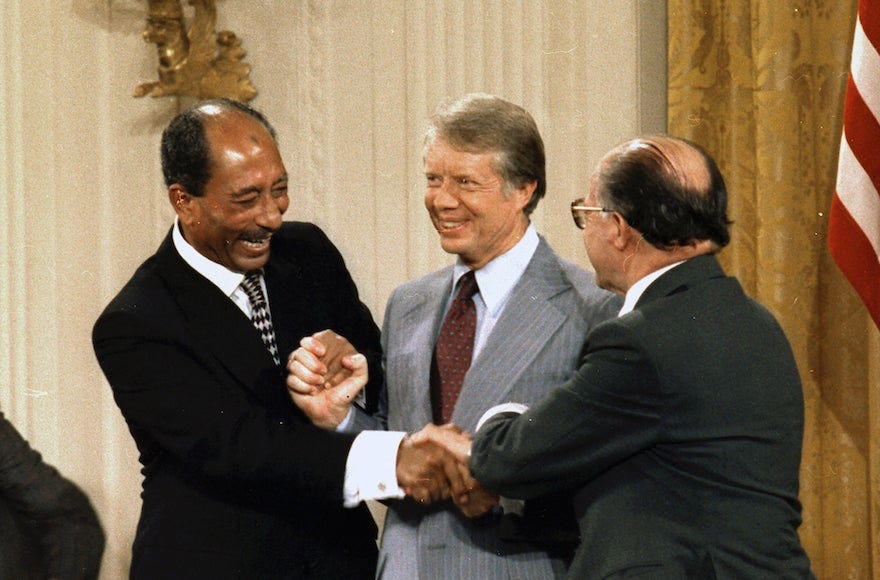
My article goes on to look at a quartet of VPs who rose to the top. In Egypt, Sadat rose to the occasion while his successor Mubarak muddled through. The ill-fated Isabel Perón of Argentina (Perón’s third wife was no Evita), was overthrown. But my favorite is probably Gennady Yanayev, the last VP of the Soviet Union. David Remnick in his Pulitzer prize-winning Lenin’s Tomb: The Last Days of the Soviet Empire, states that Yaneyev had a public reputation as a drunk. Remnick then notes notes:
I’m not sure it is possible to describe just how hard it is to acquire a reputation as a drunk in Russia.
Zyuganov was visibly drunk when he tried to assert authority after the coup attempt against Gorbachev. His “presidency” lasted all of three days.
As for Delcy Rodríguez, she’s a sharper and more capable figure than most VPs. As I’ve written elsewhere, the VP of Venezuela is more akin to prime minister, and exercises real power. She has been pragmatic in reaching out to the Venezuelan business community and overseas an intelligence agency and all-important oil industry.
Really insightful take on the VP succession issue. That Egyptian joke about leaders picking successors dumber than themselves nails the paradox perfectly, and its kinda wild how this pattern shows up cross-culturally. The Yanayev example was particuarly striking I had no idea the bar for being a "known drunk" in Russia was that high.