

The Vice President Eats Shit
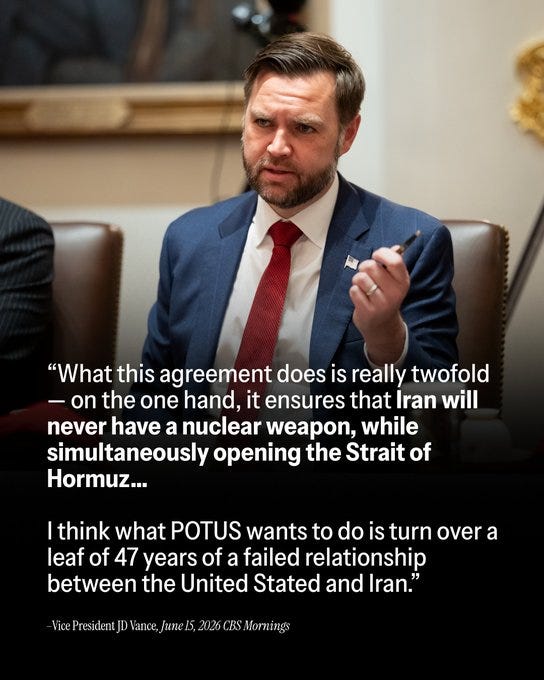
Vance will own the Iran Deal

New book out, new baby coming, and fun new project at home—life at home is pretty good for Vice President J.D. Vance these days.

But at the office, not so good.
Anyone with a toxic boss will recognize Vance’s situation. The boss made a really terrible decision to start a war with Iran. Vance made it known that he didn’t think it was a great idea, but the boss is the boss.
The war went badly and the boss has agreed to a humiliating deal to end it. But he has assigned the VP to work out the details, most of which are up in the air. Since the U.S. is tired of war and the high gas prices that have come with it, Vance won’t have any leverage. We’ve lost the war, there is no appetite to start fighting again, so threats to Iran will ring hollow.
Throughout this war the U.S. has been hampered by relying on amateur diplomats like Steve Witkoff and Jared Kushner who negotiated without the support of experts who know the issues. According to Politico’s Nahal Toosi, every indication is that this situation will continue to be the case.
Vance is going into negotiations without leverage and without deep expertise and background. Imagine buying a car and being so desperate that you can’t walk away and you know nothing about the details of comparable car prices or financing. You’re gonna get got. That’s Vance’s new assignment.
It gets worse.
The boss is set to retire in 2028 and Vance wants to replace him. On the one hand, ending the war to bring down energy prices and reduce inflation is a must if the GOP is to have any chance in the mid-terms or in 2028. At the same time, key elements of the GOP are still super-hawkish about Iran and will see the inevitable bad agreement as a betrayal.
South Carolina Senator and uber-hawk Lindsey Graham posted:
I am somewhat concerned that Iran’s view of the agreement seems different than what the American negotiating team is claiming.
Under our law, any nuclear deal with Iran will be sent to Congress for review and a vote. I look forward to reviewing the final product and I believe it is imperative that the architect of the deal, Vice President Vance and his negotiating partners, be part of the process in presenting the final deal to Congress.
I added the emphasis. Graham, with a re-election campaign to run, dare not cross Trump so he’ll pin responsibility for the foreign policy fiasco on Vance.
JD Vance will be stuck selling a bad deal to his fickle boss, a divided Congress and party, and an American public that is no longer buying what this White House is selling.
I am not the first to observe that being a politician is eating a heaping helping of shit, over and over and over again.
Vice Presidential Humiliations Past
The vice presidency is an inherently humiliating job. But most presidents did not explicitly humiliate their VPs. For the most part, the vice president wasn’t important enough to bother humiliating—at least not publicly. As the Vice Presidency has risen in stature, they increasingly have been put in humiliating, or at least difficult positions.
Many difficult moments for vice presidents came when they had tough assignments or were defending a president in crisis. On the former, VP Harris had a tough time on immigration. But President Biden gave her that assignment because the administration needed help on a serious problem.
In the 1980 primaries, President Carter faced a challenge from Sen. Ted Kennedy. He had also placed an embargo on grain sales to the Soviet Union in response to their invasion of Afghanistan. VP Mondale opposed the embargo both because he felt it wouldn’t make a difference (grain sales are fungible) and because he was worried about the Iowa primaries. Carter thought the embargo was necessary to show U.S. allies that an American president could make a politically costly decision when needed in the face of Soviet aggression. (Carter was right.) Mondale dutifully campaigned in Iowa, one of many tough jobs he took on for Carter.
Gerald Ford played loyal vice president during Watergate. This had an element of humiliation as the walls closed in on Nixon, but Nixon wasn’t purposefully doing it to Ford. The same goes for Clinton and Gore, who had a warm president-vice president relationship through most of the administration. But, when Clinton was being impeached and tried, Gore had to be a loyal defender of some presidential tawdriness. Again, this was not purposeful humiliation.
Eisenhower went back and forth on Nixon. In his heart of hearts, Eisenhower didn’t like him, but Nixon was Nixon and remained persistent, eventually winning some measure of Eisenhower’s respect.
At an August 1960 press conference, when Nixon was running for President, Eisenhower was asked about Nixon’s contributions to the administration. Eisenhower responded, “If you give me a week, I might think of one. I don’t remember.”
Eisenhower apologized to Nixon and it occurred in the context of a weekly press briefing, so in fact Eisenhower was saying that he’d bring them answers next time they met. (I’m not sure that he did though.)
I don’t think Eisenhower was purposely humiliating Nixon here, but subconsciously he never really liked Nixon and it came out.
LBJ was a monster and readily took out his enormous rage on Vice President Hubert Humphrey. It was bad enough that the songwriter-humorist-math professor Tom Lehrer wrote a song about it.
Pence: VP Abased
The VP who can most relate to Vance’s humiliation as Trump’s VP is probably Pence. The most notable instance was Trump forcing Pence to leave an Indianapolis Colts game if players chose to kneel during the national anthem. Pence loved his Colts, but Pence showed his obeisance, and continued to do so to almost the very end.
Vance might consider how that turned out.