

I never thought teaching American foreign policy to Chinese students would be so rewarding
Building empathy by showing them the world through American eyes

Over the spring semester I taught a group of students from China about American foreign policy. Last week they graduated from their program at the University of Maryland with Masters degrees. I absolutely loved teaching them and I am very proud of them.
They relished the chance to study in the United States. I couldn’t help but be charmed by their respect for their teachers. They brought me little gifts and applauded at the end of my lectures. At their graduation, everyone wanted a picture with me. I felt like a celebrity. Their pride and joy at their achievement was infectious.1
I didn’t try to convince them that U.S. foreign policy is always wise and well-intentioned. (Hell, I don’t believe that!) But I tried to teach them to see the world through American eyes. Our actions in the world come from places—hard national interest, domestic constituencies, and ideas about ourselves and the world—that need to be understood and respected.
Note: There’s a bit of Veepology at the end!
Lenses for Examining American Foreign Policy
In teaching American foreign policy, I don’t just tell stories, describe events, or highlight trends. I try to provide my students with lenses to better understand what the U.S. is doing and why. Two particular approaches are favorites of mine. The first is universal and applies to international affairs and foreign policy globally. They other is more specifically American.
Wheels within Wheels
One my my revelatory moments studying for my PhD came reading the classic Essence of Decision. In it Graham Allison and Philip Zelikow examine the Cuban missile crisis at three different levels. First they look at it as a geopolitical chess match between two nation-states. But they also examine how the organizational processes of the two states shaped the decision-making. The way in which intelligence was collected and processed affected what leaders knew and when they knew it. The fact that the U.S. Navy had a viable blockade plan, whereas the Air Force’s plans for bombing Cuba weren’t workable, shaped the final decision. Finally, the authors examined the bureaucratic politics level, the push and pull between Kennedy’s national security advisors. This concept of wheels within wheels shaping the decision-making and implementation of policy fascinated me and was central to my own dissertation.
In his Interpreting NAFTA: The Science and Art of Political Analysis, Frederick Mayer blew up the Allison and Zelikow three-levels of analysis into a 3x3 table to examine the negotiations and passage of the North American Free Trade Agreement. 2x2 tables are ubiquitous in social science but 3x3s…) There are three levels, but there are also three modes.
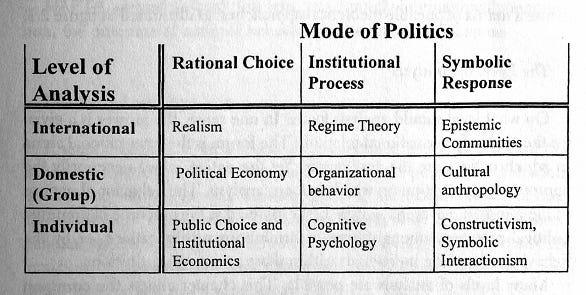
Rational choice is about maximizing utility or efficiency. At the top level, nations pursue their national interests in calculating manner. Organizations seek the most efficient means of achieving their ends (think corporations maximizing profit). Individuals pursue their preferences.
Institutional process is about how institutions (which include organizations but can also refer to long-standing arrangements)2 shape behavior. Individuals too, under class economic theory, seeks to get more of what they want and less of what they don’t want. Nations may enter treaties that limit the pursuit of their interests. Organizations (particularly government agencies) often operate in conditions of uncertainty where the optimal path to achieving objectives is unclear. Instead they develop and rely on standard operating procedures. Individuals too, have internal processes known as heuristics, to make rapid decisions under conditions of uncertainty.
Finally, symbolic processes is about ideals and identity. Nations have unique ways of viewing the world and their place in it. Organizations may have an organizational culture that shapes who joins, who leaves, and how the organization defines its procedures and goals. Individuals too, have unique ideas about the world. Things happen when enough people embrace a particular idea or group of ideas to bring about changes.
Despite the neatness of the table, the lines are not hard and fast. The concepts bleed into one another. None has perfect explanatory power for world events, but having this menu of explanations can be useful to understand different facets of a major issue or event. The point is not to always get the “right answer,” about which level and mode applies, but rather to better understand complex situations by understanding the many factors at play.
Competing Schools
The second lens provided is from Walter Russell Mead’s Special Providence: American Foreign Policy and How it Changed the World. Mead argues that there are four major schools of American foreign policy, each of which has been preeminent at different times in U.S. history. Each has virtues and weaknesses, but the tension between the schools has made American foreign policy more effective overall and allowed the U.S. to advance its goals effectively.
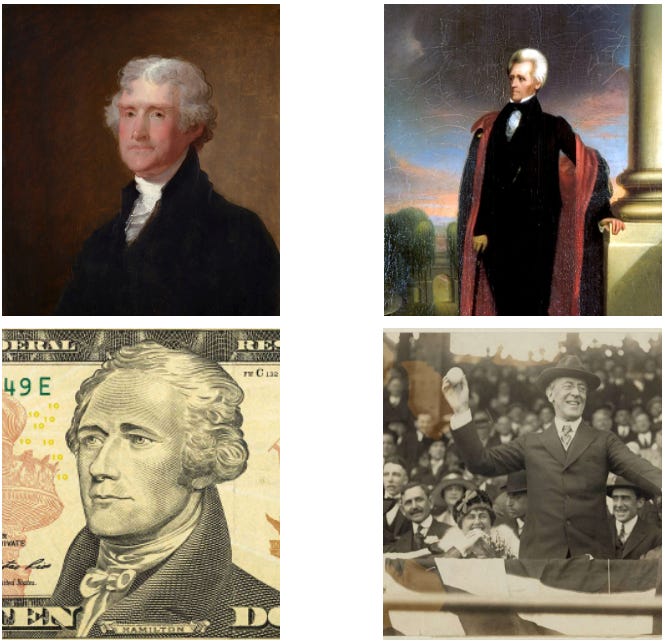
Hamiltonians are named for Alexander Hamilton and are advocates for commerce and trade. They are also advocates of a strong military to protect American commercial and political interests around the globe. Overall this has probably been the dominant school of U.S. foreign policy. At its best it advances a worldview of “win-win,” instead of viewing international relations as a zero-sum game. The relentless focus on trade and commerce can have costs that the Hamiltonians don’t recognize, including domestic losers from free trade. They are also too ready to cozy up to unsavory regimes in pursuit of markets and opportunities.
Wilsonians are named for Woodrow Wilson, but pre-date him. They are the idealists, they want to advance human rights and increase cooperation among nations. Wilson is not a well-regarded figure now for many reasons, including his own racism. His idealism could lead to ill-conceived international agreements or adventures. At its worst, this worldview becomes a figleaf for imperialism. Nonetheless, the U.S. has, at times, advanced human rights and its core values of freedom and equality, which in turn has burnished the nation’s reputation as more than just another great power on the world stage.
The Jacksonians, named for Andrew Jackson, are nuts and bolts patriots. They treasure personal freedom and want a strong United States. They are very skeptical of elites and mistrust grand global ambitions. Mead describes Trump’s rise in terms of being a “Jacksonian Revolt,” in probably the best single article on Trumpism. J.D. Vance’s recent rhetoric can be seen in this light as well. Dismissed by many, the Jacksonians treasure personal dignity and independence. They are ready to defend the nation and are the backbone of the U.S. military.
Finally the Jeffersonians, while not isolationist, view too much intercourse with the world as a threat to American democracy. War creates the need for strong militaries and intelligence services. Trade fosters powerful business elites. All of these things can undermine individual liberty and government of the people, by the people, and for the people—the very cornerstone of the United States. Mead notes the Jeffersonian virtues, unlike the other schools they are cautious in their approach to the world and modest in their ambitions. Some of the greatest figures in U.S. foreign policy such as John Quincy Adams and George Kennan were Jeffersonians (according to Mead). Jeffersonians can tend to isolationism, which proved a grave mistake in the decade before World War II.
Again, these schools aren’t strict delineations. Most Americans engaged in foreign policy have ideas and tendencies pulling from multiple schools. The point is not to strictly categorize different figures or strategies. Rather, it is too understand these different viewpoints and how they are deeply rooted in American history and identity and how they then shape U.S. foreign policy.
Giving Away Secrets or Building Relationships
If we are competing with China, should I be teaching them about U.S. foreign policy? I’ll answer with a resounding yes! Nothing I teach is secret or even secret adjacent. But better they hear about the U.S. and its role in the world from me than from a professor in China who may have their own deep biases. Better we understand each other as people. Maybe our competition will be fierce, maybe Cold War is unavoidable. But all of these things will be worse if we cannot understand each other and our differing worldviews.
I didn’t sugarcoat things. The U.S. has real issues with China, some of which are about our interests (like many trade issues), while others deeply rooted in our values (like human rights for the Uighurs).
One of my core themes in teaching is that—whatever the situation, whether it’s within a government agency or an international negotiation—the other players are coming from somewhere. They have their own internal politics, concerns, organizational procedures, identity, etc. They are as driven by circumstances out of their control as you are.
Better to understand this and be able to see the world through the eyes of others.
Veeps of China
I told my students about my particular interest in vice presidents, and they humored me. They asked me questions and even provided me some background about the vice presidency of China!
For the first half-century of the Communist regime, the presidency and vice presidency either didn’t exist or were figureheads. Real power was in the hands of the party chiefs. But over time symbolic and party positions were increasingly held by the same person, first under President Jiang Zemin, then President Hu Jintao, and now under President Xi Jinping. The first two stepped down after two terms as president. Jiang Zemin’s second vice president was Hu Jintao and his appointment to the vice presidency was a signal that he had been designated the successor. Similarly Hu Jintao’s second vice president was Xi Jinping. As VP, Xi took on substantial roles—particularly liaising with then U.S. Vice President Joe Biden.
Xi is now in an unprecedented third-term as president and his vice presidents have gone back to the symbolic roles of most of their predecessors. The current VP Han Zheng was appointed to the role after stepping down from the all-powerful Politburo Standing Committee, clarifying that he was not a potential president. Like other VPs, Zheng does take on symbolic roles like receiving foreign heads of state and attending the St. Petersburg International Economic Forum to expound on joint Russo-Chinese efforts to establish a new world order.
Applying the analyses above, it is easy to characterize Zheng’s speech as further evidence of China’s grand plans to displace the U.S. on the world stage. But China’s efforts to build this alternate international order haven’t amounted to much—despite U.S. mistepts. This rhetoric could just as easily reflect China’s fear of how much the U.S. dominates the world stage. Neither position is absolutely correct. In understanding China both possible positions should be considered to understand where China is coming from and what they are doing. That’s the type of thing I am trying to teach.
My own enthusiasm for the subjects I teach has also been described as infectious.
The word institution comes from the Latin for arrangement or custom. They are established to ease the conduct of life. Money is an institution, it’s easier to have an agreed upon currency than barter for everything and constantly negotiate prices and value. It applies to organizations that make facilitate life as well—having standing courts is easier than establishing one ad hoc.
Re the Cuban Missile Crisis, you write, "The fact that the U.S. Navy had a viable blockade plan, whereas the Air Force’s plans for bombing Cuba weren’t workable, shaped the final decision." Actually, the JCS unanimously, i.e., including the CNO, recommended bombing and invading Cuba. Kennedy's decision, initially, was to accept their advice. His brother dissuaded him.